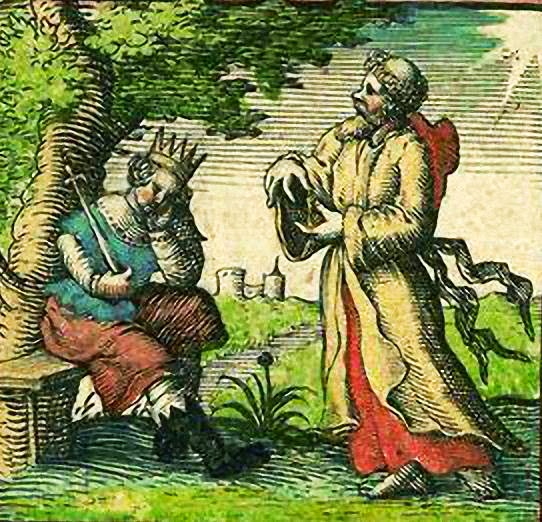
Monday, February 9, 2015

500 years ago, the Mennonites were a cursed sect of the Anabaptists led by a former priest named Menno Symons (1496 - 1561). "Seize and apprehend him and throw him in prison!"

"Menno Simons from Friesland" 1608 engraving by Christoffel van Sichem

The Mennonites are a cursed sect of the Anabaptists led by a former priest named Menno Symons -- seize and apprehend him and throw him in prison!

Alsatian Mennonite woman, from the 18th or 19th century. Plate from the collection "Costumes de divers pays" (Clothing of various countries), Lanté et Gatine (1827) - The Alsatian Museum, Strasbourg


"The error of the cursed sect of the Anabaptists … would doubtless be and remain extirpated, were it not that a former priest Menno Symons … has misled many simple and innocent people," complained a letter to the regent of the Netherlands in 1541. "To seize and apprehend this man we have offered a large sum of money, but until now with no success. Therefore we have entertained the thought of offering and promising pardon and mercy to a few who have been misled … if they would bring about the imprisonment of the said Menno Symons." 

The Emperor joins the witch hunt but Menno is never caught

Rembrandt, The Mennonite Preacher Anslo and his Wife, 1641


Holy Roman Emperor Charles V joined in the hunt, offering 100 gold guilders for Menno's arrest. One Dutch man was broken on the wheel and executed merely for allowing Menno to stay with him. But the former priest, a pacifist armed with ideas but no weapons, was never caught. Instead, he led the Anabaptists out of their radical, violent, millennialist fantasies into a moderate, devotional, pacifist movement. Neither the first nor the most original interpreter of the radical Reformation's Anabaptism, he was such an outstanding leader that the movement today is known by his name: Mennonites. 

Menno starts out refusing to read the Bible

Des mennonites alsaciens en 1815. Charles Mathiot, Roger Boigeol, Recherches historiques sur les anabaptistes de l'ancienne principauté de Montbéliard, d'Alsace et du territoire de Belfort, Flavion (Belgique), Éd. Le Phare, p.339 (coll. « Essais sur l'histoire du protestantisme français »).


Little is known about Menno's early life until his ordination as a priest at age 28. Though educated in a monastic school and trained for ministry, he had never even touched the Scriptures. "I feared if I should read them they would mislead me," he later wrote. "Behold! Such a stupid preacher was I for nearly two years." 

The church Menno was born into deceived him

Birth of Mennonite movement by Ammon Monroe Aurand, Jr., 1938


After those two years, he had a crisis of faith. The bread and wine he dispensed at each Mass did not seem to transubstantiate into Christ's body and blood as Roman Catholic doctrine taught. He figured such thoughts had been suggested by the Devil, and prayed for God to ward them off. "Yet, I could not be freed from this thought," he wrote. "Finally, I got the idea to examine the New Testament diligently. I had not gone very far when I discovered that we were deceived, and my conscience, troubled on account of the aforementioned bread, was quickly relieved." 

Menno leaves the church he was born into to preach the Word of God but continues to gamble and drink

Portrait of the Amsterdam Mennonite Brak family, Tibout Regters (1710–1768)


Believing the Bible to be authoritative, Menno developed the reputation as an "evangelical" preacher. "Everyone sought and desired me," he recounted. "It was said that I preached the Word of God and was a good fellow." But to Menno, it was a lie; his life was still empty and full of "diversions" like gambling and drinking. 

Menno cannot find any infant baptism in the Bible
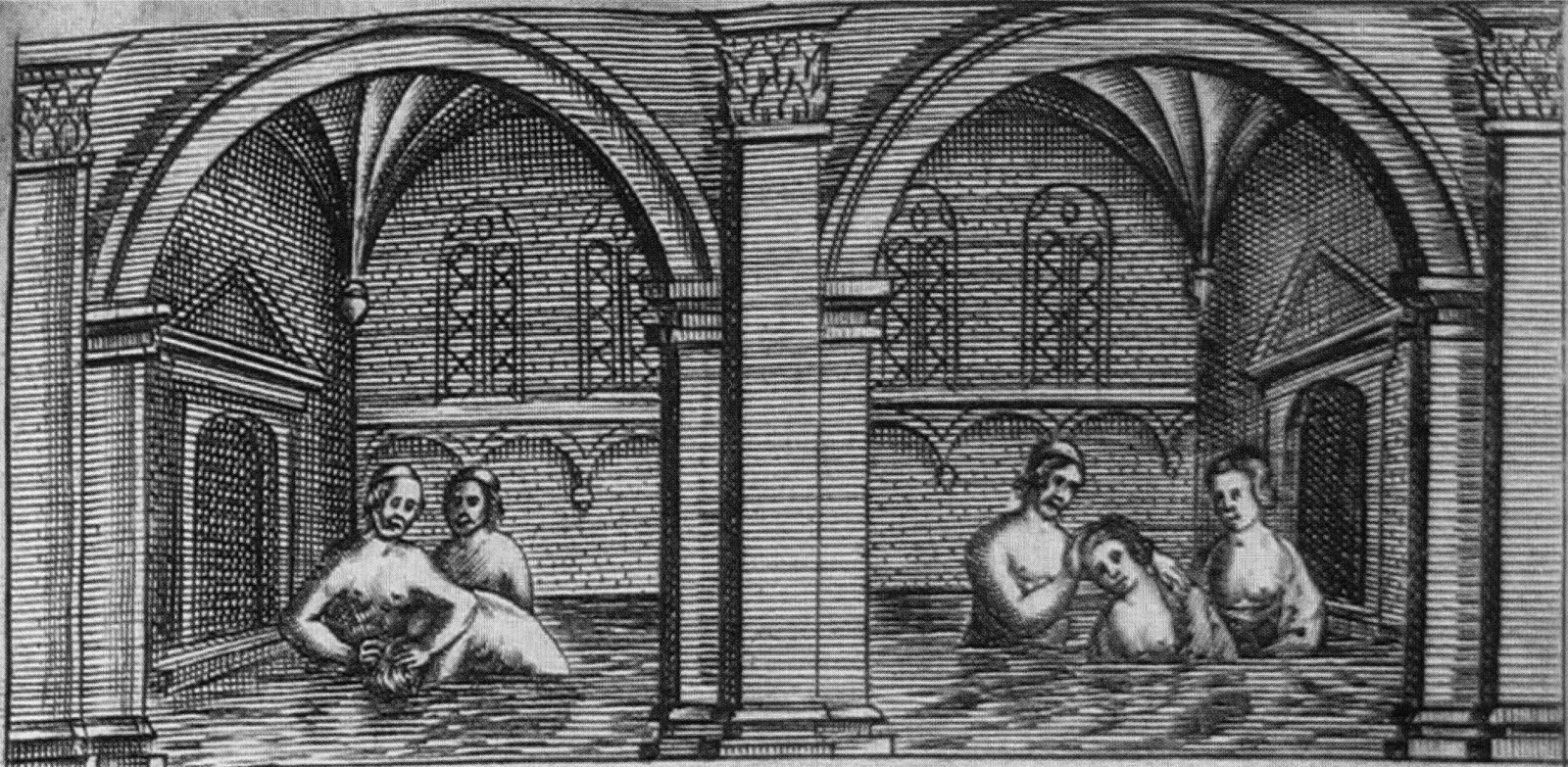
Alles begann mit Ansgar. Hamburgs Kirchen im Spiegel der Zeit (Hamburg: Pressestelle der Freien und Hansestadt Hamburg, 2006), p. 48, 1750.


Three years later, an otherwise unknown Leeuwarden Anabaptist was beheaded, sending Menno into another spiritual crisis. "It sounded very strange to me to hear of a second baptism," he wrote. "I examined the Scriptures diligently and pondered them earnestly but could find no report of infant baptism." Again, he wrote, "I realized that we were deceived." But his life changed little: "I spoke much concerning the Word of the Lord, without spirituality or love, as all hypocrites do."

Anabaptists capture a town and are willing to die for their beliefs


The burning of a 16th-century Dutch Anabaptist, Anneken Hendriks, who was charged by the Spanish Inquisition with heresy.

Eventually, he was hit with a final crisis. Three hundred violent Anabaptists, dreaming of the imminent end of the world and attempting to escape persecution, captured a nearby town—and were savagely killed by the authorities. Among the dead was Menno's brother, Peter. 

"I saw that these zealous children, although in error, willingly gave their lives and their estates for their doctrine and faith … But I myself continued in my comfortable life and acknowledged abominations simply in order that I might enjoy comfort and escape the cross of Christ." 

Menno preaches Anabaptist theology from his Catholic pulpit

Menno Simons, Leipzig, 1854.

The realization led to an emotional, tearful cry to God for forgiveness. For nine months thereafter he essentially preached Anabaptist doctrine from his Catholic pulpit, until he finally left the church and (a year later) fully cast his lot with the radical Reformers. 

Even Protestant Reformers like Martin Luther and John Calvin oppose the Anabaptists


Historical drawing of the execution of the leaders of the Münster rebellion. In the background the cages are already in place at the old steeple of St. Lambert's church


At the time, however, Anabaptists were unloved by all. Even Protestant Reformers like Martin Luther and John Calvin opposed them as "fanatics," "scatterbrains," and "asses"—just as bad as the papists. Those feelings weren't helped in 1535 when a despotic Anabaptist leader took over the town of Münster, ruling as a cruel theocratic dictator until Catholic and Protestant troops overran the city in bloody battle. 

Menno leaves the Catholic church and is ordained as an Anabaptist

Photograph of an old order Mennonite, horse and carriage in Oxford County, Ontario, Canada by Allan Walker, 2006.


Menno was as worried about the violent Anabaptists as anyone and had even tried to stem their fanaticism as a priest. Sympathetic, he knew they had zeal without knowledge. But once he left the Catholic church, he met a group of peaceful Anabaptists who strongly opposed Münsterite thinking. He joined them and was ordained. 

Menno spreads Anabaptist propaganda throughout the Netherlands and Germany

George W. Bush meets with Amish and Mennonite residents in Lancaster, PA. Date : Wednesday, Aug. 16, 2006.  White House photo by Kimberlee Hewitt


For the rest of his life, Menno (and, later, his wife and his children) lived in constant danger as heretics. He traveled throughout the Netherlands and Germany, writing extensively and establishing a printing press to circulate Anabaptist teaching. He took the Bible extremely literally, sometimes even legalistically; though he defended the doctrine of the Trinity in a small book, he refused to use the term because it did not appear in Scripture. 

Menno defends the faith against Catholic and Protestant attacks


Portrait of Jan van Leiden (Anabaptist Leader) as King of Münster by Heinrich Aldegrever, in prison shortly before his execution, 1536.  Menno wrote The Blasphemy of Jan van Leyden
His writings aren't the most articulate Anabaptist theological treatises, nor are they the first. But they served to defend the faith against both Catholic and Protestant attacks and to distance the group from more zealous militants. In one of his first writings, The Blasphemy of Jan van Leyden, Menno opposed the unchristlike "proponents of the sword philosophy": "It is forbidden to us to fight with physical weapons … This only would I learn of you whether you are baptized on the sword or on the Cross?" 

Menno is a pacifist

Detail of portrait of the regents of the Mennonite orphanage, Haarlem, 1834. Jan Adam Kruseman (1804–1862)

The Christian's duty was to suffer, not fight, Menno believed. "If the Head had to suffer such torture, anguish, misery, and pain," he asked, "how shall his servants, children, and members expect peace and freedom as to their flesh?" 

Menno practices shunning of excommunicated church members

Mennonite on the cell phone, Serge Melki from Indianapolis, USA, 2010.

In his later years, he was occupied with other internal Mennonite struggles, mainly over shunning excommunicated church members. But in each of his writings (more than 40 survive), he began by quoting Paul's letter to the Corinthians: "No other foundation can any one lay than that which is laid, which is Jesus Christ." He finally laid his pen down at age 66, as he became ill on the twenty-fifth anniversary of his renunciation of the Catholic church. The next day, he died a natural death. Today nearly 900,000 Mennonites follow his teachings.

Source: Galli, Mark and Ted Olson, eds. 131 Christians Everyone Should Know. Nashville: B&H Publishing Group, 2000, pages 166-168.

Tuesday, February 3, 2015

Bede (673-735) documents the abolition of idolatry and the adoption of the truth of Christianity upon its first introduction in Britain 1,400 years ago

The Venerable Bede (673-735)

OF THE COUNCIL HE HELD WITH HIS CHIEF MEN ABOUT EMBRACING THE FAITH OF CHRIST, AND HOW THE HIGH PRIEST PROFANED HIS OWN ALTARS. [A.D. 627.]

The Chief the the Priests confesses to the King that the gods that they are currently worshipping are worthless and that they should immediately adopt Christianity


St Edwin of Northumbria (616 - 633), King of Deira and Bernicia

THE king, hearing these words, answered, that he was both willing and bound to receive the faith which he taught; but that he would confer about it with his principal friends and counsellers, to the end that if they also were of his opinion, they might all together be cleansed in Christ the Fountain of Life. Paulinus consenting, the king did as he said; for, holding a council with the wise men, he asked of every one in particular what he thought of the new doctrine, and the new worship that was preached? To which the chief of his own priests, Coifi, immediately answered, "O king, consider what this is which is now preached to us; for I verily declare to you, that the religion which we have hitherto professed has, as far as I can learn, no virtue in it. For none of your people has applied himself more diligently to the worship of our gods than I; and yet there are many who receive greater favours from you, and are more preferred than I, and are more prosperous in all their undertakings. Now if the gods were good for any thing, they would rather forward me, who have been more careful to serve them. It remains, therefore, that if upon examination you find those new doctrines, which are now preached to us, better and more efficacious, we immediately receive them without any delay." 

Another of the King's chief men urges adoption of Christianity due to the brevity of human life


Depiction of Edwin from John Speed's 1611 "Saxon Heptarchy".

Another of the king's chief men, approving of his words and exhortations, presently added: "The present life of man, O king, seems to me, in comparison of that time which is unknown to us, like to the swift flight of a sparrow through the room wherein you sit at supper in winter, with your commanders and ministers, and a good fire in the midst, whilst the storms of rain and snow prevail abroad; the sparrow, I say, flying in at one door, and immediately out at another, whilst he is within, is safe from the wintry storm; but after a short space of fair weather, he immediately vanishes out of your sight, into the dark winter from which he had emerged. So this life of man appears for a short space, but of what went before, or what is to follow, we are utterly ignorant. If, therefore, this new doctrine contains something more certain, it seems justly to deserve to be followed." The other elders and king's councillors, by Divine inspiration, spoke to the same effect. 

Coifi confesses that the worship of the false gods is superstition, that their temples and altars should be destroyed, and that instead they should worship the True God


A page from a copy of Bede's Lives of St. Cuthbert, showing King Athelstan presenting the work to the saint. This manuscript was given to St. Cuthbert's shrine in 934.


But Coifi added, that he wished more attentively to bear Paulinus discourse concerning the God whom he preached; which he having by the king's command performed, Coifi, hearing his words, cried out, "I have long since been sensible that there was nothing in that which we worshipped; because the more diligently I sought after truth in that worship, the less I found it. But now I freely confess, that such truth evidently appears in this preaching as can confer on us the gifts of life, of salvation, and of eternal happiness. For which reason I advise, O king, that we instantly abjure and set fire to those temples and altars which we have consecrated without reaping any benefit from them." In short, the king publicly gave his licence to Paulinus to preach the Gospel, and renouncing idolatry, declared that he received the faith of Christ: and then he inquired of the high priest who should first profane the altars and temples of their idols, with the enclosures that were about them, he answered, "I; for who can more properly than myself destroy those things which I worshipped through ignorance, for an example to all others, through the wisdom which has been given me by the true God?" Then immediately, in contempt of his former superstitions, he desired the king to furnish him with arms and a stallion; and mounting the same, he set out to destroy the idols; for it was not lawful before for the high priest either to carry arms, or to ride on any but a mare. Having, therefore, girt a sword about him, with a spear in his hand, he mounted the king's stallion and proceeded to the idols. The multitude, beholding it, concluded he was distracted; but he lost no time, for as soon as he drew near the temple he profaned the same, casting into it the spear which he held; and rejoicing in the knowledge of the worship of the true God, he commanded his companions to destroy the temple, with all its enclosures, by fire. This place where the idols were is still shown, not far from York, to the eastward, beyond the river Derwent, and is now called Godmundinghan, where the high priest, by the inspiration of the true God, profaned and destroyed the altars which he had himself consecrated.

Source:

Bede, Ecclesiastical History of the English Nation. Book 2, Chapter 13.  Translator not clearly indicated (But it seems to be L.C. Jane's 1903 Temple Classics translation), introduction by Vida D. Scudder, (London: J.M. Dent; New York E.P. Dutton, 1910).


Folio 3v from the St Petersburg Bede (a manuscript of Bede's Ecclesiastical History of the English People)

Wednesday, January 28, 2015

Wishing to worship the Supreme Being, Emperor Constantine the Great of Rome (272 - 337 AD) converts to Christianity and simultaneously changes world history.

Colossal marble head of Emperor Constantine the Great, Roman, 4th century

Constantine's Testimony

Constantine the Great, mosaic in Hagia Sophia, c. 1000

"To acknowledge ... in solemn terms the beneficence of the Supreme Being is by no means boasting. He searched for and chose my service to carry out his purpose. Starting ... at the faraway Britannic sea and the regions where the sun ... sets, by the help of the Supreme Power, I drove out and scattered all the prevailing evil things, in order that the human race, reared with my assistance, might call upon the service of the holy law ... I am firmly convinced that I owe my life and every breath ... to the Supreme God."

Constantine's Letter to King Sapor of Persia

Colossal head of Constantine, from a seated statue: a youthful, classicising, other-worldly official image (Metropolitan Museum of Art)[


I profess the most holy religion.  I confess that as a disciple of the Holy God I observe this worship.  With the power of this God on my side to help me, beginning at the boundaries of the Ocean, I had gathered every nation, one after another, throughout the world, to the certain hope of salvation ... This God I worship and my army is dedicated to him and wears his sign on their shoulders, marching directly wherever the cause of justice summons them.  I confess that I honour this God with never-dying remembrance, this God in the height of his glory I delight to contemplate with a pure and simple heart.

The Conversion of Constantine

Constantius appoints Constantine as his successor by Peter Paul Rubens, 1622


Throughout the fourth century, relations between the church, the emperor, and pagan religion were changing continually.  Constantine's defeat of Maxentius at the Battle of the Milvian Bridge in the autumn of 312, and his interpretation of that victory as the response of the Christian God to his prayer for help, propelled church and state into a new age for which neither was prepared.  Out of this new relationship between Christian church and Christian emperor stemmed the turbulent history of church/state relations in the later Roman Empire and throughout the Middle Ages.

Constantine prays to God.  The response from God is a cross in the noonday sky

The Battle of the Milvian Bridge by Giulio Romano


Constantine's account of his conversion, told by the emperor himself to the Church historian Eusebius of Caesarea towards the end of his life, is well known.  Constantine, alarmed by reports of Mazentius' mastery of magical arts, prayed to the "Supreme God" for help.  The response was a sign, a cross in the noonday sky 'above the sun', and with it the words, 'Conquer by this.'  That night Christ appeared to Constantine in a dream and commanded him to use the sign -- apparently Chi-Rho, the initial letters of the name of Christ -- 'as a safeguard in all engagements with his enemies'.  According to the historian Lactantius, Constantine put this sign on the shields of his soldiers, and then marched on Rome, confronted Maxentius -- who was miraculously induced to fight outside the city fortifications -- and conquered.

Though converting to Christianity, Constantine maintains pagan customs

The Baptism of Constantine, as imagined by students of Raphael


This story has been doubted.  But Constantine's attitude towards the Christian church after he became emperor, and his new laws, demonstrate that his allegiance to Christianity was genuine, though his understanding of the Christian faith was at first no doubt imperfect.  Indeed, Constantine did retain the pagan high priest's title of Pontifex Maximus; for a decade his coins continued to feature some of the pagan gods, notably his own favourite deity, the Unconquered Sun; and he delayed Christian baptism until the end of his life.  However, delayed baptism was the custom of the age, a device for avoiding mortal sin; and retaining the pagan symbols was a necessary compromise with his pagan subjects, still very much in the majority.


A gold multiple of "Unconquered Constantine" with Sol Invictus, struck in 313 AD. The use of Sol's image appealed to both the educated citizens of Gaul, who would recognize in it Apollo's patronage of Augustus and the arts; and to Christians, who found solar monotheism less objectionable than the traditional pagan pantheon.


Constantine treated Christianity as the favoured, though not yet the official, religion of the Empire.  He granted immunities to the clergy and lavished gifts on the church; in his letters and edicts he spoke as if the Christian God were his own.

Constantine's previous religion was the worship of the Unconquered Sun

A representation of Jesus as the sun-god Helios/Sol Invictus riding in his chariot. Mosaic of the 3rd century on the Vatican grottoes under St. Peter's Basilica.


It is important to understand Constantine's previous religion, the worship of the Unconquered Sun.  If the story of the cross in the sky is true, he may have interpreted the sign as his own special deity commending the worship of the Christian God.  Perhaps Constantine continued to identify the sun with the Christian God in some way -- a belief made easier by the tendence of Christian writers and artists to use sun imagery in portraying Christ.  For them, Christ is the source of light and salvation; a mosaic from a third-century tomb found under St. Peter's, Rome, even shows him as the sun god in his chariot.  When in 321 Constantine made the first day of the week a holiday, he called it 'the venerable day of the Sun' (Sunday).

Constantine and his mother build churches

Church of the Holy Sepulchre in Jerusalem

Another result of Constantine's conversion was renewed interest in the Holy Land by people in the West.  Since the failure of the Second Jewish Revolt of Bar Kokhba (132-135), Jerusalem had been a pagan city; Constantine and his mother Helena now made it Hadrian's Temple of Venus, and Helena discovered what was believed to be the 'True Cross' on which Jesus had been crucified.  Here -- with the Church of the Holy Sepulchre -- and elsewhere, Constantine and Helena built churches, and pilgrims came in increasing numbers to the holy places.

Christianity and Pagan Customs

Ave, Caesar! Io, Saturnalia! (1880) by Lawrence Alma-Tadema

The Christian church began to take over pagan ideas and images.  From sun-worship, for example, came the celebration of Christ's birth on December 25, the birthday of the sun.  Saturnalia, the Roman winter festival of December 17-21, provided the merriment, gift-giving, and candles typical of later Christmas holidays.  Sun-worship hung on in Roman Christianity, and Pope Leo I, in the mid-fifth century, rebuked worshippers who turned round to bow to the sun before entering St. Peter's Basilica in Rome.  Some pagan customs which were later Christianized, for example the use of candles, incense, and garlands, were initially avoided by the church because they symbolized paganism.

Sources:

Dowley, Tim, ed. Introduction to the History of Christianity, Second Edition. Minneapolis: Fortress Press, 2013, pages 104-106.

Eusebius of Caesarea, Life of Constantine 2.28-29 and 4.9, trans. Paul Keresztes, in "Constantine: Called by Divine Providence" in Elizabeth A. Livingstone, ed. Tudia Patristica (Kalamazoo, MI: Cistercian Publications, 1985).

Friday, January 16, 2015

Perpetua (d. 203 AD) would have died as an irrelevant person in a history of billions of irrelevant persons -- except she was willing to die for Jesus Christ

Stained-glass window of St Perpetua of Carthage (church of Notre-Dame of Vierzon, France, 19th century): martyrdom of St Perpetua and her fellows in the stadium of Carthage; Saint Felicity on her left
We have little idea what brought Perpetua to faith in Christ, or how long she had been a Christian, or how she lived her Christian life. Thanks to her diary, and that of another prisoner, we have some idea of her last days—an ordeal that so impressed the famous Augustine that he preached four sermons about her death.

Roman Emperor Septimius Severus (145 AD - 211 AD) decides to cripple Christianity


Septimius Severus at Glyptothek, Munich.
Perpetua was a Christian noblewoman who, at the turn of the third century, lived with her husband, her son, and her slave, Felicitas, in Carthage (in modern Tunis). At this time, North Africa was the center of a vibrant Christian community. It is no surprise, then, that when Emperor Septimius Severus determined to cripple Christianity (he believed it undermined Roman patriotism), he focused his attention on North Africa. Among the first to be arrested were five new Christians taking classes to prepare for baptism, one of whom was Perpetua.

Perpetua's pagan father tries to convince her to deny Jesus Christ


Mosaic of Saint Perpetua, Croatia.
Her father immediately came to her in prison. He was a pagan, and he saw an easy way for Perpetua to save herself. He entreated her simply to deny she was a Christian.

"Father do you see this vase here?" she replied. "Could it be called by any other name than what it is?"

"No," he replied.

"Well, neither can I be called anything other than what I am, a Christian."

In the next days, Perpetua was moved to a better part of the prison and allowed to breast-feed her child. With her hearing approaching, her father visited again, this time, pleading more passionately: "Have pity on my gray head. Have pity on me, your father, if I deserve to be called your father, if I have favored you above all your brothers, if I have raised you to reach this prime of your life."

He threw himself down before her and kissed her hands. "Do not abandon me to be the reproach of men. Think of your brothers; think of your mother and your aunt; think of your child, who will not be able to live once you are gone. Give up your pride!"

Perpetua was touched but remained unshaken. She tried to comfort her father—"It will all happen in the prisoner's dock as God wills, for you may be sure that we are not left to ourselves but are all in his power"—but he walked out of the prison dejected.

Perpetua is put on trial before governor Hilarianus and her father tries to dissuade her again

An acrylic painting depicting Christian martyrs Perpetua and Felicity by Mojaveprincess

The day of the hearing arrived, Perpetua and her friends were marched before the governor, Hilarianus. Perpetua's friends were questioned first, and each in turn admitted to being a Christian, and each in turn refused to make a sacrifice (an act of emperor worship). Then the governor turned to question Perpetua.

At that moment, her father, carrying Perpetua's son in his arms, burst into the room. He grabbed Perpetua and pleaded, "Perform the sacrifice. Have pity on your baby!"

Hilarianus, probably wishing to avoid the unpleasantness of executing a mother who still suckled a child, added, "Have pity on your father's gray head; have pity on your infant son. Offer the sacrifice for the welfare of the emperor."

Perpetua replied simply: "I will not."

"Are you a Christian then?" asked the governor.

"Yes I am," Perpetua replied.

Perpetua's father continues to try to convince her to deny Jesus Christ

Mary and Child with Saints Felicity and Perpetua (Sacra Conversazione), 1520, Anonymous (Polish)
Her father interrupted again, begging her to sacrifice, but Hilarianus had heard enough: he ordered soldiers to beat him into silence. He then condemned Perpetua and her friends to die in the arena.

Perpetua and the other convicts are sent to the gladiators to die

Painting showing the martyrdom of Perpetua, Felicitas, Revocatus, Saturninus and Secundulus, from the Menologion of Basil II (c. 1000 AD)

Perpetua, her friends, and her slave, Felicitas (who had subsequently been arrested), were dressed in belted tunics. When they entered the stadium, wild beasts and gladiators roamed the arena floor, and in the stands, crowds roared to see blood. They didn't have to wait long.

Immediately a wild heifer charged the group. Perpetua was tossed into the air and onto her back. She sat up, adjusted her ripped tunic, and walked over to help Felicitas. Then a leopard was let loose, and it wasn't long before the tunics of the Christians were stained with blood.

This was too deliberate for the impatient crowd, which began calling for death for the Christians. So Perpetua, Felicitas, and friends were lined up, and one by one, were slain by the sword.

As a result of the martyrdom of Perpetua and Felicitas at Carthage (North Africa) in 203, it was reported that the local prison governor was converted.

From Perpetua's Diary of Her Imprisonment

"Perpetua’s Ladder," Speculum Virginum, ca. 1140. London, British Library, MS Arundel 44, fol. 93v.

Perpetua confronts her father

La Grazia Perpetua

While we were under arrest, my father, out of his love for me, tried to persuade me to shake my resolve.

"Father," I said.  "Do you see this vase here, for example, or this water pot or whatever?"

"Yes," he said.

"Could it be called anything other than what it is?" I asked.

"No."

"Well, in the same way, I can't be called anything except what I am -- A Christian."

My father was so angry at the word "Christian" that he made as if he would tear my eyes out.  But he left it at that and departed, defeated along with his devilish arguments.

During those few days I was baptized, and I was inspired by the Spirit not to ask for any other favour after the water, except physical perseverance.

Perpetua had a baby before being imprisoned

Galleria di Francesco I, perdita della gioventù perpetua (1530)

A few days later we were lodged in the prison.  I was terrified, as I had never been in such a dark hole.  What a terrible time it was!  With the overcrowding, the heat was stifling.  There was also the extortion of the soldiers -- and on top of everything else, I was tormented with worry about my baby.

I had to endure these trials for days.  Then I obtained permission for my baby to be with me in prison.  Immediately I regained my health, relieved of worry and anxiety about the child.  Prison suddenly became a palace; I wanted to be there more than anywhere else.

Pepetua is put on trial for refusing to sacrifice to the emperors and her father pleads with her

Église Sainte-Perpétue et Sainte-Félicité de Nîmes

Then one day, while we were having breakfast, we were suddenly rushed off to court.  We arrived at the forum, and immediately the news flew around the neighbourhood and a huge crowd gatehred.  We entered the prisoners' dock.  When they were questioned, the others all admitted their guilt.  When my turn came, my father appeared with my son, dragged me from the bench, saying, "Make the sacrifice -- have pity on your baby!"

Hilarianus, the governor who succeeded the late proconsul Minicius Timianus as judge, said, "Have pity on your father's grey head; have pity on your infant son!  Offer the sacrifice for the well-being of the emperors!"

"I will not," I replied.

"Are you a Chrsitian?" said Hilarianus.

"I am!" I confessed.

Then Hilarianus passed sentence on all of us: we were condemned to the beasts.

We returned to prison in high spirits.


Perpétue et Félicité, Église de Tébourba, Public Library of Tebourba


Sources:

Perpetua's Diary of Her Imprisonment

Dowley, Tim, ed. Introduction to the History of Christianity, Second Edition. Minneapolis: Fortress Press, 2013, page 60.

Galli, Mark and Ted Olson, eds. 131 Christians Everyone Should Know. Nashville: B&H Publishing Group, 2000, pages 362-363.

Wednesday, January 7, 2015

Before becoming a "saint" and a doctor of the church, Augustine (354-430) amused himself by stealing pears with his friends in North Africa.


Giovanni Bellini, The Carrara Madonna, 1487, including a pear in the bottom right hand corner.

Augustine admits to stealing (and loving it!)

Portrait of a boy, three-quarter-length, in a black costume and a white ruff, holding a pear;  Lorenz Strauch (1554-1630)

 If the crime of theft which I committed that night as a boy of sixteen were a living thing, I could speak to it and ask what it was that, to my shame, I loved in it. I had no beauty because it was a robbery. It is true that the pears which we stole had beauty, because they were created by you, the good God, who are the most beautiful of all beings and the Creator of all things, the supreme Good and my own true Good. But it was not the pears that my unhappy soul desired. I had plenty of my own, better than those, and I only picked them so that I might steal. For no sooner had I picked them than I threw them away, and tasted nothing in them but my own sin, which I relished and enjoyed. If any part of one of those pears passed my lips, it was the sin that gave it flavour.

Augustine considers why he enjoyed, and was attracted to, stealing, and how this relates to his relationship with God


The Fortunes of a Street Waif, an illustration from the book Needham, George Carter () Street Arabs and Gutter Snipes

And now, O Lord my God, now that I ask what pleasure I had in that theft, I find that it had no beauty to attract me. I do not mean beauty of the sort that justice and prudence possess, nor the beauty that is in man's mind and in his memory and in the life that animates him, nor the beauty of the stars in their allotted places or of the earth and sea, teeming with new life born to replace the old as it passes away. It did not even have the shadowy, deceptive beauty which makes vice attractive - pride, for instance, which is a pretence of superiority, imitating yours, for you alone are God, supreme over all; or ambition, which is only a craving for honour and glory, when you alone are to be honoured before all and you alone are glorious for ever. Cruelty is the weapon of the powerful, used to make others fear them: yet no one is to be feared but God alone, from whose power nothing can be snatched away or stolen by any man at any time or place or by any means. The lustful use caresses to win the love they crave for, yet no caress is sweeter than your charity and no love is more rewarding than the love of your truth, which shines in beauty above all else. Inquisitiveness has all the appearance of a thirst for knowledge, yet you have supreme knowledge of all things. Ignorance, too, and stupidity choose to go under the mask of simplicity and innocence, because you are simplicity itself and no innocence is greater than yours. You are innocent even of the harm which overtakes the wicked, for it is the result of their own actions. Sloth poses as the love of peace: yet what certain peace is there besides the Lord? Extravagance masquerades as fullness and abundance: but you are the full, unfailing store of never-dying sweetness. The spendthrift makes a pretence of liberality: but you are the most generous dispenser of all good. The covetous want many possessions for themselves: you possess all. The envious struggle for preferment: but what is to be preferred before you? Anger demands revenge: but what vengeance is as just as yours? Fear shrinks from any sudden, unwonted danger which threatens the things that it loves, for its only care is safety: but to you nothing is strange, nothing unforeseen. No one can part you from the things that you love, and safety is assured nowhere but in you. Grief eats away its heart for the loss of things which it took pleasure in desiring, because it wants to be like you, from whom nothing can be taken away.

Augustine realizes that in stealing, he was ursurping God

Detail of Sistine Chapel fresco Creation of the Sun and Moon by Michelangelo (c. 1512)

So the soul defiles itself with unchaste love when it turns away from you and looks elsewhere for things which it cannot find pure and unsullied except by returning to you. All who desert you and set themselves up against you merely copy you in a perverse way; but by this very act of imitation they only show that you are the Creator of all nature and, consequently, that there is no place whatever where man may hide away from you.

Augustine is the slave who ran away from his master (God) and chased a shadow instead by enjoying doing wrong

Gustave Boulanger's painting The Slave Market

What was it, then, that pleased me in that act of theft? Which of my Lord's powers did I imitate in a perverse and wicked way? Since I had no real power to break his law, was it that I enjoyed at least the pretence of doing so, like a prisoner who creates for himself the illusion of liberty by doing something wrong, when he has no fear of punishment, under a feeble hallucination of power? Here was the slave who ran away from his master and chased a shadow instead! What an abomination! What a parody of life! What abysmal death! Could I enjoy doing wrong for no other reason than that it was wrong?

Augustine's theft did not make him happy


Rōnin (a samurai with no lord or master during the feudal period (1185–1868) of Japan) robbing a merchant's house in Japan around 1860.  Photo from "Sketches of Japanese Manners and Customs", by J. M. W. Silver, Illustrated by Native Drawings, published in London in 1867

It brought me no happiness, for what harvest did I reap from acts which now make me blush particularly from that act of theft? I loved nothing in it except the thieving, though I cannot truly speak of that as a 'thing' that I could love, and I was only the more miserable because of it. And yet, as I recall my feelings at the time, I am quite sure that I would not have done it on my own. Was it then that I also enjoyed the company of those with whom I committed the crime? If this is so, there was something else I loved besides the act of theft; but I cannot call it 'something else', because companionship, like theft, is not a thing at all.

Augustine experienced pleasure from the crime rather than from the pears


Still Life With Quince, Apples, and Pears by Paul Cézanne (1839–1906)

No one can tell me the truth of it except my God, who enlightens my mind and dispels its shadows. What conclusion am I trying to reach from these questions and this discussion? It is true that if the pears which I stole had been to my taste, and if I had wanted to get them for myself, I might have committed the crime on my own if I had needed to do no more than that to win myself the pleasure. I should have had no need to kindle my glowing desire by rubbing shoulders with a gang of accomplices. But as it was not the fruit that gave me pleasure, I must have got it from the crime itself, from the thrill of having partners in sin.

How can I explain my mood? It was certainly a very vile frame of mind and one for which I suffered; but how can I account for it? Who knows his own frailties?

The prank tickles Augustine and his gang with laughter


Lachende Weiber (Smiling women) by Károly Kotász (1872–1941)

We were tickled to laughter by the prank we had played, because no one suspected us of it although the owners were furious. Why was it, then, that I thought it fun not to have been the only culprit? Perhaps it was because we do not easily laugh when we are alone. True enough: but even when a man is all by himself and quite alone, sometimes he cannot help laughing if he thinks or hears or sees something especially funny. All the same, I am quite sure that I would never have done this thing on my own.

Augustine did not steal the pears for gain but to experience enjoyment with his friends


Poire verte et couteau (green pear and knife). Signed Marcoussis. 1941.

My God, I lay all this before you, for it is still alive in my memory. By myself I would not have committed that robbery. It was not the takings that attracted me but the raid itself, and yet to do it by myself would have been no fun and I should not have done it. This was friendship of a most unfriendly sort, bewitching my mind in an inexplicable way. For the sake of a laugh, a little sport, I was glad to do harm and anxious to damage another; and that without thought of profit for myself or retaliation for injuries received! And all because we are ashamed to hold back when others say 'Come on! Let's do it!'

Saint Augustine. Confessions. Translated by R.S. Pine-Coffin. London: Penguin Group, 1961, Books II.6, II.8, II.9, pages 49-52.

Douglas F. Kelly compares God's ability to speak light into the dark human soul and make it reborn to God's speaking light into existence.

The Sending Forth of Light The Ancient of Days  ( William Blake , 1794) A third divine action occurred on the first day of creation: ...