Monday, May 30, 2016

Sources as diverse as the Bible and Socrates advise people to submit to their government even to the point of going to war

THE BIBLICAL ARGUMENT:
GOVERNMENT IS ORDAINED OF GOD


A shocked mandarin in Manchu robe in the back, with Queen Victoria (UK), William II (Germany), Nicholas II (Russia), Marianne (France), and Mutsuhito (Japan) cutting up a king cake with Chine ("China" in French) written on it.


Scripture seems emphatic on this point.  Government is of God.  Whether in the religious or the civil realm, God is the God of order and not of chaos (Genesis 9:6; 1 Corinthians 14:33, 40).


OLD TESTAMENT DATA ON GOD AND GOVERNMENT


The Ancient of Days (William Blake, 1794)


From the very beginning, Scripture declares that humankind is to "have dominion over ... every living thing that moves upon the earth" (Genesis 1:28).  Humankind is to be king over all the earth.  After the fall the woman is told, "Your desire shall be for your husband, and he shall rule over you" (Genesis 3:16).  When Cain killed Abel, the text implies that he failed to realize that he was his "brother's keeper" (Genesis 4:9-10).  Finally, when the whole antediluvian civilization had become corrupt and "the earth was filled with violence" (Genesis 6:11), God destroyed it and instituted human government.  God said to Noah and his family after the flood, "For your lifeblood I will surely require a reckoning ....' of every man's brother I will require the life of man."  For "whoever sheds the blood of man, by man shall his blood be shed; for God made man in his own image" (Genesis 9:5-6; man = humankind).


The Pyramid of Capitalist System is a common name of a 1911 American cartoon caricature critical of capitalism, closely based on a Russian flyer of c. 1900. The graphic focus is on social stratification by social class and economic inequality


In brief, God ordained human government.  Adam was given the crown to reign over the earth.  And then evil became rampant, and Noah was given the sword to enforce that rule.  Government is of God both because order is from God and because disorder must be put down for God.  Humans have the right from God to take the lives of unruly human beings who shed innocent blood.  Government is invested with divine power.


Battle scene from the Morgan Bible of Louis IX showing 13th-century swords


The sword given to Noah was used by Abraham when he engaged in war against the kings who had committed aggression against Abraham's nephew Lot (Genesis 14).  This passage indicates God's approval of wars that protect the innocent from aggressors.


Samuel anoints David as King, Dura Europos, Syria, 3rd century CE

Although the specific form of government changed throughout the Old Testament, there is a reiteration of the principle that government is of God.  In Mosaic theocracy, the powers of government are quite explicit: "You shall give life for life, eye for eye, tooth for tooth, hand for hand, foot for foot, burn for burn, wound for wound, stripe for stripe" (Exodus 21:23-25).  Even when Israel set up its monarchy contrary to God's plan (1 Samuel 8:7), God nevertheless anointed their choice of a king.  God said to Samuel the prophet, "Hearken to their voice, and make them a king (1 Samuel 8:22).  Later Samuel said, "Do you see him whom the LORD has chosen?" (1 Samuel 10:24).  Even before David was king, he was commanded to fight against the Philistines, who were robbing Israel (1 Samuel 23:1).


Since government is given by God, it follows that to disobey government is to disobey God


The spiked heads of executed criminals once adorned the gatehouse of the medieval London Bridge.


As far as the governments of Gentile nations were concerned, the Old Testament declares that "the Most High is sovereign over the kingdoms of men and gives them to anyone he wishes" (Daniel 4:5).  And from the rest of Daniel's prophecy, it is clear that God ordained the great Babylonian, Medo-Persian, Greek, and Roman governments (Daniel 2-7).  Thus the text indicates that God has ordained government wherever it is found.  And since government is given by God, it follows that to disobey government is to disobey God.  If, therefore, the country's government commands a person to go to war, biblical activism argues that one must respond in obedience to the Lord, for the Lord has ordained the government with the sword, the power to take lives.


NEW TESTAMENT DATA ON GOD AND GOVERNMENT

Ecce Homo ("Behold the Man"), Antonio Ciseri's depiction of Pilate presenting a scourged Jesus to the people of Jerusalem.  In this scene, Jesus Christ, "in whom all things were created" (Colossians 1:16), submits to government.


The New Testament confirms the view of the Old Testament that God has ordained government.  Jesus declares that we should "give to Caesar what is Caesar's" (Matthew 22:21).  That civil authority is God-given is further acknowledged by Jesus before Pilate: "You would have no power over me if it were not given to you from above" (John 19:11).  Paul admonishes Timothy to pray and give thanks "for kings and all those in authority" (1 Timothy 2:2).  Titus is exhorted to "remind the people to be subject to rules and authorities, to be obedient" (Titus 3:1).  Peter is very clear: "Be subject for the Lord's sake to every human institution, whether it be to the emperor as supreme, or to governors as sent by him" (1 Peter 2:13-14).


He is God's servant, an agent of wrath to being punishment on the wrongdoer


Hester Prynne at the Stocks - an engraved illustration from an 1878 edition of The Scarlet Letter


The most extensive passage in the New Testament on the relation of the Christian to government is found in Romans 13:1-7.  The first verse makes it clear that all government is divinely established: "Everyone must submit himself to the governing authorities, for there is no authority except that which God has established."  Therefore, "he who rebels against the authority is rebelling against what God has instituted, and those who do so will bring judgment on themselves (verses 1-2).  The further reason given for obeying a ruler is that "he is God's servant to do you good .... He is God's servant, an agent of wrath to being punishment on the wrongdoer" (verse 4).


Government is ordained of God and whoever resists one's government is resisting God


Pieter Brueghel the Younger, The tax collector's office, 1640

Paul writes, "This is also why you pay taxes, for the authorities are God's servants, who give their full time to governing" (verse 6).  In view of this, the Christian is urged to "pay all of them their dues, taxes to whom taxes are due, revenue to whom revenue dis due, respect to whom respect is due, honor to whom honor is due" (verse 7).  What is especially significant about this passage of Scripture is that it is the New Testament's reiteration of the power of government to take a human life.  Christians are urged to obey the existing governor or king, "for he does not bear the sword in vain" (verse 4).  Government, with its power over life, is "ordained of God," and whoever resists one's government is resisting God (Romans 13:1-2).  It would follow from this, according to biblical activists, that one ought to respond to the government's call to take part in war because God has given the authority of the sword to governing authorities.


THE PHILOSOPHICAL ARGUMENT:
GOVERNMENT IS HUMANS' GUARDIAN


The Death of Socrates, by Jacques-Louis David (1787)


Activism is defended by arguments outside the Bible as well.  One of the most powerful defenses of this position comes from Plato's dialogue Crito.  In it, he offers three explicit reasons (and two more implied ones) why a person should not disobey even a government that is unjustly putting him to death.  The scene is the prison where Socrates awaits his death after he has been charged with impiety and sentenced to drink the cup of poison.  Socrates' young friend Crito urges him to escape and evade the death penalty.  In reply, Socrates gives five reasons for obeying an unjust government, even to the point of death.


Government is the human's parent


Charity, by French painter William-Adolphe Bouguereau

One ought not disobey even an unjust government.  "First, because in disobeying it he is disobeying his parent."  By this Socrates means that under the sponsorship of government, the individual is brought into the world.  One is not born into a lawless jungle but comes into this world under the parentage of the state.  The state makes one's very birth more than barbaric: it is a birth into a state of civilization rather than into anarchy.  Just as parents spend months in preparation and anticipation for a child, many years have likewise been spent in maintaining the state, which makes a civilized birth possible, and these years may not be lightly regarded later because a person finds oneself at odds with the government.  If one were to disobey the government, says Socrates, would it not reply, "In the first place did we not bring you into existence?  Your father married your mother by our aid and begat you.  Say whether you have any objection to urge against those of us who regulate marriage.  None, I should reply."


Government is the human's educator


Adriaen van OstadeThe Schoolmaster, 1662


Socrates offers another reason for obedience to one's government.  "Second, because it is the author of his education."  The implication here is that the very education making persons what they are (including their knowledge of justice and injustice) was given to them by their government.  They are civilized, and not barbarian, not only by birth but also by training.  And both the birth and training were made possible by the government that is now demanding one's life.  What can one reply against governments that "after birth regulate the nurture and education of children, in which you also were trained?  Were not the laws, which have the charge of education, right in commanding your father to train you in music and gymnastic?  Right, I should reply."  From this it follows that government could say to us, "Since you were brought into the world and nurtured and educated by us, can you deny in the first place that you are our child and slave, as your fathers were before you?"  And if this is true, people are not on equal terms with their government.  They have no more right to strike back at it and revile it than one does to hit one's mother or father.  Even if government would destroy us, we have no right to destroy it in return.  Persons who think that they do have such a right have "failed to discover that [their] country is more to be valued and higher and holier far than mother or father or any ancestor."  Government is not only prior to the individual citizen, but also superior to the citizen as well.


The governed have a duty to obey government


Marie Antoinette's execution on October 16, 1793


The third reason Socrates gives for a person obeying the government is that "he has made an agreement with [it] that buy pledging allegiance to that government, binds them to its laws.  By the very fact that one takes a given country as one's own country, that person has thereby made a tacit covenant to be obedient to its commands.  Hence, "when we are punished by [our country], whether with imprisonment or stripes, the punishment is to be endured in silence; and if she leads us to wounds or death in battle, thither we follow as is right."  For if people accept the privileges of education and protection of their government, then they have thereby implicitly agreed to accept the responsibility to obey their government's laws, submit to its penalties, and even to go to war for it.


The governed are free to leave their government


The execution of Robespierre.


There are at least two other implied arguments that Socrates uses to content that one ought not disobey one's government.  "Anyone who does not like it and the city, l may go where he likes ... But he who has experience of the manner in which we [rulers] order justice and administer the State, and still remains, has entered into an implied contract that he will do as we command him."  Socrates makes it clear, however, that whatever emigrating a person is going to do must be done before being indicted or drafted by one's country.  To flee in the face of one's responsibilities to the government is "doing only what a miserable slave would do, running away and turning your back upon the compacts and agreements which you made as a citizen."  Those who are not willing to obey their country should find another country that they can obey.  Persons who assume the protection and privilege of a country by constant presence there as citizens must not seek exile simply because the country's demands are undesirable.


Without government, there would be social chaos

 Ministry of Interior Iraqi Federal Police perform a riot control demonstration in the civil disorder management course on Camp Dublin, Baghdad, Iraq, Aug 20, 2011.


Another reason one should not disobey one's government is implied in Socrates' question "And who would care about a State which has no law?"  An unjust law is bad, but no law is even worse.  Even a bad monarchy is to be preferred to anarchy.  Any government is better than no government at all; if people were to disobey their government in what they felt was unjust or undesirable, social chaos would result.  If obedience to government were determined individually or subjectively, then no law would be immune from some citizen's disapproval or disobedience, and the result would be chaos.  To adapt a phrase from Scripture, having no laws that are binding on all citizens would be for everyone to do what is right in their own eyes (cf. Judges 21:25).  And the result would not be a society but a social chaos.


Even a government that is closed to its citizens would be better than one open to revolution among its peoples.  In these give arguments Plato states the major points used as basis for activism.  Persons should always obey their government because it is their guardian.  Government, even one that seems to be unjust, should be obeyed to the point of going to war.  For without government, humans would be no better than savages, living in a state of ignorance and anarchy.  Hence, no matter how undesirable their responsibilities to their government may be, persons nevertheless are obligated to obey it as their parent and master.


Source:  Geisler, Norman L. Christian Ethics: Contemporary Issues and Options, 2nd ed. Grand Rapids, MI: Baker Academic, 2010, pages 220-224.


Monday, May 9, 2016

Augustine (354-430 A.D.) speculates about the age of the earth and concludes that the Bible is a better source than Ancient Egyptian and Ancient Greek sources

Of the falseness of the history which ascribes many thousands of years to times gone by


Plato's Atlantis described in Timaeus and Critias


Such men are also misled by certain wholly untruthful writings which purport to contain the history of many thousands of years of time.  For we compute from the sacred writings that six thousand years have not yet passed since the creation of man.  Hence, the writings which make reference to far more thousands of years than there have been are vain, and contain no trustworthy authority on the subject.  But we shall not devote a great deal of argument to showing this.  Rather, let us cite only that letter which Alexander the Great wrote to his mother Olympias, giving her the narrative which he had received from a certain Egyptian priest, which the latter had taken from writings held to be sacred among the Egyptians, and which contained an account of kingdoms known also to Greek History.


Ancient sources differ as to the length of the Assyrian, Greek, Persian and Macedonian empires


Belus (the Babylonian god Marduk rather than the legendary king of Assyria) from Guillaume RouillĂ©'s Promptuarii Iconum Insigniorum


According to this same letter of Alexander, the duration of the kingdom of Assyria exceeded five thousand years.  In the Greek history, however, only some 1,300 years are recorded from the reign of Belus himself, whom the Egyptian sources also identify as the first lord of that kingdom.  Again, the Egyptian priest assigns more than eight thousand years to the empire of the Persians and Macedonians down to the time of Alexander, to whom he was speaking; whereas, among the Greeks, 485 years are assigned to the Macedonians down to the death of Alexander, and the Persian empire is reckoned to have lasted for 233 years until brought to an end by Alexander's victory.


Greek and Egyptian history conflict so trust the Scriptures


The Great Sphinx and the Pyramids of Giza, built during the Old Kingdom.


The Greek history therefore gives a much smaller number of years than does the Egyptian.  Indeed, the Greek figures would not equal the Egyptian even if multiplied by a factor of three.  For it is said that, in former times, the Egyptians had so short a year that it ended after only four months; so that the fuller and truer years which both they and we now have would contained three of their old years.  But not even thus, as I have said, does the number of ages contained in the Greek history agree with that given by the Egyptian; and so we must be more ready to have faith in the former, for it does not exceed the true account of the years contained in our writings, which are truly sacred.


The divine books foretold that the whole world would believe in them and the whole world has believed


Page from Codex Vaticanus; ending of 2 Thes and beginning of Heb dating from 300 to 325 AD


Moreover, if the account of the ages given in this celebrated letter of Alexander differs so greatly from things probable and credible, how much less may we believe those other writings which, though full of fabulous accounts of supposed antiquities, our adversaries wish to set against the authority of our most noted and divine books! -- the books which foretold that the whole world would believe in them, and in which, as they foretold, the whole world has indeed believed.  For the truth of the account of the past given in these books is shown by the very fact that their predictions of future evens have been so entirely fulfilled.


Of those who suppose not that this world is everlasting, but either that there are innumerable worlds, or that one and the same world is eternally being born and dissolved at the conclusion of a fixed cycle of ages


In this diagram, the Big Crunch is the universe that is born and dissolved.


There are others who, though they do not believe that this world is everlasting, are of opinion either that it is not the only world, but that there are innumerable worlds, or that it is indeed the only one, but that it arises and perishes at fixed intervals, and that this happens innumerable times.  But those who think in this latter way must necessarily confess that the race of human beings existed before there were other men to beget them.  For, unlike those who think that there are floods and conflagrations which do not affect the entire world, these cannot suppose that, when the whole world perishes, some men always remain, whose offspring then replenish the original population.  Rather, since they believe that the world itself is reborn out of its own material, so also must they believe that the human race is first produced from the elements of the world, and that only then does the  progeny of mortal men, like that of other animals, come teeming from their parents.

What reply is to be given to those who raise the question of the lateness of man's creation


The Creation of Adam is a fresco painting by Michelangelo, which forms part of the Sistine Chapel's ceiling, painted c. 1511–1512. It illustrates the Biblical creation narrative from the Book of Genesis in which God breathes life into Adam, the first man.


When the question of the origin of the world arose, I answered those who refuse to believe that the world has not always existed that -- as even Plato himself most clearly confesses (although not a few people consider that his real belief is at odds with what he says) -- it had a beginning.  Now, in the same way, I replay to those who wonder why man was not created during the innumerable and infinite ages of the past, but was created so late that, as we find in Sacred Scripture, fewer than six thousand years have elapsed since he began to exist.  If it troubles them that, according to our authorities, so short a time has passed since man's creation, and that his years are so few, let them reflect that nothing which has a limit is long, and that, compared to endless eternity, all the expanses of finite time must be considered very little, or, indeed, nothing at all.  For this reason, if we said that there had elapsed not five or six thousand years since God made man, but even 60,000 or 600,000 or 60 or 600 or 600,000 times that number, or this sum multiplied again and again until we came to numbers for which we no longer had a name, we could still ask the same question: Why did He not make man before?


For the eternity during which God refrained from creating man is so great that it stretches backwards from us without any beginning.  Therefore, no matter how great and ineffable the number of ages with which it is compared may be, such an expanse of time, so long as it has a definite conclusion, should not be regarded as being even so big as the smallest drop of water in the entire sea, or, indeed, in the ocean that surrounds the world.  For of these two things, one, indeed is extremely small and the other incomparably great; but both are finite.  And as to that expanse of time which comes forth from some beginning and is terminated by some end: no matter how great its extent, if it be compared with that which has not beginning, I do not know whether to say that we should call in the very smallest thing, or nothing at all.  Suppose we take a finite expanse of time and, working backwards, subtract the briefest moments from it one by one, as you might take one day at a time from a man's life, starting with the day in which he now lives and going back to that of his birth.  Even if the number of moments that you must subtract during this backward progression is so huge that no word can be found for it, this subtraction will nonetheless at some stage lead you back to a beginning.  But now take a time which has no beginning, and, working backwards, take away from it, I do not say tiny moments one by one, or hours, or days, or months, or years, or even periods of years, but expanses of time so great that they cannot be counted by anyone whatsoever.  Subtract expanses of time as great as that which we have supposed to be gradually consumed by the deduction of moments, and subtract them not once or twice or gain and again, but for ever -- and what do you achieve or accomplish by doing this?  You never reach a beginning, for there is no beginning.  Assuming, then, that the mortal condition of mankind continues for so long to decay and be renewed, and assuming also that our posterity remains as weak and ignorant as we are, our descendants might with the same curiosity ask after 600,000 years what we ourselves now ask after a mere five thousand.  The same question might have been put by those who lived before us, when the time of man's creation was still recent.  The first man himself, indeed, might, on the day after he was made, or on the very same day, have asked why he was not made sooner.  And no matter how much sooner he might have been made, this controversy as to the beginning of temporal things would have had no more meaning then than it does not or would have at any later time.


Source: Augustine.  The City of God against the Pagans. Edited and translated by R.W. Dyson. Cambridge: Cambridge University Press, 1998, Book XII, chapters 11, 12, and 13, pages 512 to 516.


Tuesday, January 26, 2016

Slavic peoples from Czech to Russia have the Bible to thank for their written language

Slavic tribes from the 7th to 9th centuries in Europe


MISSION TO MORAVIA


Saints Cyril and Methodius holding the Cyrillic alphabet," a mural by Bulgarian iconographer Z. Zograf, 1848, Troyan Monastery


The two brothers, Cyril and Methodius, had grown up near Slavs who had settled in Macedonia and therefore they knew the Slavic language.  Before embarking upon their mission, the evangelists began to prepare an alphabet for the hitherto unwritten language, so that the converts could have the Scriptures and liturgy in their native tongue.  This script, known as Glagolitic, was the forerunner of the form of writing now used in sotuh-eastern Eurpoe and Russia, w hich is called Cyrillic, after the younger brother.  By this means, Orthodox Christianity, and with it the culture of Byzantium, spread among the Slavic tribes.  This Byzantine culture determined the main lines of development for these peoples, especially the Russians, for centuries.  Thus Cyril and Methodius rightely earned the title of 'The Apostles of the Slavs'.

VLADIMIR'S CHOICE


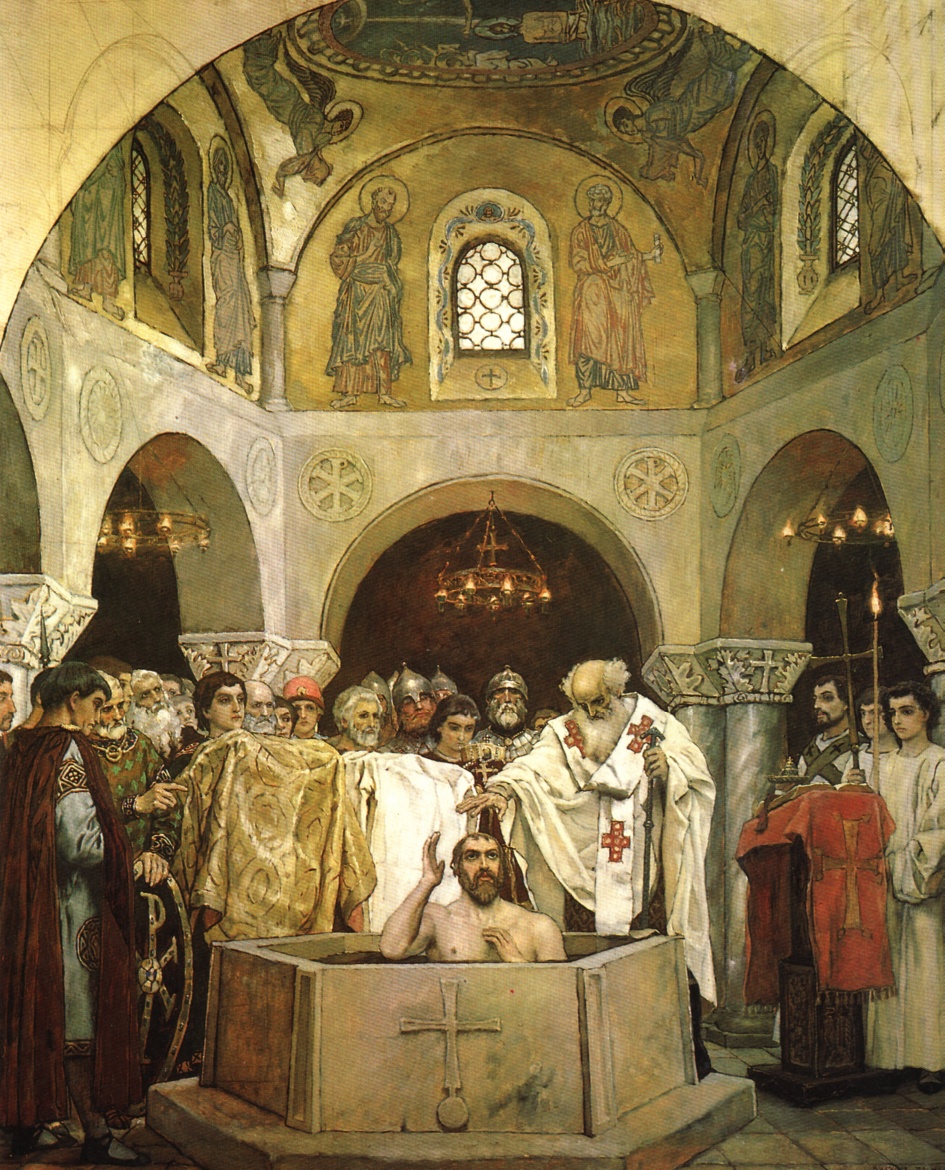
The Baptism of Saint Prince Vladimir, by Viktor Vasnetsov (1890)

The most illustrious fruit of the brothers’ Slavonic influence appeared when the pagan prince of Kiev, Vladimir, officially adopted Orthodoxy as the religion of his state. The magnificent legend of the conversion of the Russians narrates how Vladimir, around 988, decided that the interests of his realm required that he take up one of the major religions. According to the Russian Chronicle, Vladimir sent envoys to investigate Islam, Judaism, Latin, and Byzantine Christianity. The first three failed to suit, but he was won over by the report of those who returned from Constantinople, declaring that when they attended the mass in the great Church of St Sophia they could not tell whether they were on earth or in heaven. Vladimir ordered the mass baptism of the Russians according to the Orthodox form, and Orthodoxy became the state religion of Russia.

Iconostasis in the Cathedral of the Annunciation in the Moscow Kremlin.

Although the details of the legend probably do not record actual history, they do reflect one of the most significant features of Russian Christianity. The forms of worship have always been more important than other aspects, such as theology or ethics. The primary appeal of Orthodoxy was aesthetic, rather than intellectual or moral. Indeed, the name of the religion in Slavonic, Pravoslavie, means ‘true worship’, reflecting the pre-eminence of the liturgy to the Russian mind.


The Baška tablet is an early example of the Glagolitic from Croatia.


After Vladimir’s conversion, the Slavonic books of Cyril and Methodius were brought to Kiev, so that the Russians received a benefit which Christians of the Latin-using Western Church did not enjoy. Their religious liturgy and writings existed in a language that was intelligible to all of them. Thus the church both civilized the Russian tribes and stimulated the growth of their native culture.


Yaroslav the Wise's consolidation of Kiev and Novgorod.

Vladimir’s son and successor, Yaroslav I, the Wise, (r. 1019–54), cemented the bonds between the Russian Church and Byzantine Orthodoxy by accepting for his realm a bishop appointed by the Ecumenical Patriarch. In this way he acknowledged Constantinople as the overseer of the Russian Church. Yaroslav provided the bishop, consecrated as the Metropolitan of Kiev, with a cathedral which he dedicated as St Sophia’s, in imitation of the mother church in Constantinople. For most of the next four hundred years, the head of the Russian Church was a Greek appointed by the Patriarch of Constantinople.


The envoys of the Roman Pope attend Alexander Nevsky

Yaroslav’s death coincided with the year traditionally regarded as marking the final rupture between the Latin and Greek Churches (1054). The newly-converted Russians quickly learned to despise the Catholics as ‘heretics’. Their hatred of the Latin Christians was greatly reinforced when German knights tried to take advantage of the chaos caused by the invasion of Russia by Genghis Khan’s Mongol hordes in the thirteenth century and launched a Catholic crusade against the northern Russians. The Western invaders were repulsed by the heroic leadership of Alexander Nevsky in 1242. He was later recognized as a saint for his achievements.


Returning to Vladimir by Yaroslav II of Vladimir after Mongol destruction. From the medieval Russian annals

Nevsky established an important precedent for the Russians by submitting voluntarily to the rule of the Khan. For over two hundred years the Russians lived under the ‘Mongol Yoke’. During this period, the Russian Church continued to be led by the Metropolitan of Kiev and Vladimir, who was usually appointed and consecrated by Constantinople, but approved by the Khan. This situation goes a long way towards explaining why Russia never experienced a Renaissance and Reformation as Western Europe did.


Source: Steeves, Paul D., "The Orthodox Church in Eastern Europe and Russia." in Introduction to the History of Christianity, Second Edition, Tim Dowley, ed.,. Minneapolis: Fortress Press, 2013, pages 104-106.

Thursday, January 21, 2016

After the shocking rape of Lucretia and her subsequent suicide, Augustine (354-430 AD) concludes that Christians should not commit self-murder


Tarquinius and Lucretia by Titian (1490–1576)
The rape of noblewoman Lucretia was a starting point of events that led to the overthrow of the Roman Kingdom and establishment of the Roman Republic. As a direct result of rape, Lucretia committed suicide. Many artists and writers were inspired by the story, including Shakespeare, Botticelli, Rembrandt, DĂ¼rer, Artemisia Gentileschi, Geoffrey Chaucer, and Thomas Heywood.


Of suicide committed through fear of punishment or dishonour


Lucretia by Lucas Cranach the Elder.


What person of human feeling, then, would refuse to forgive those women who for this reason slew themselves rather than suffer in such a way?  And as for those who refused to slay themselves, lest they avoid the crime of another only by a sin of their own: whoever makes that a matter of reproach to them will not himself escape the charge of foolishness.  For if it is not lawful for a private person on his own authority to slay even a guilty man whose death has not been authorised by any law, certainly he who slays himself is also a murderer; and the more innocent he was of that for which he thought he ought to die, the more guilty is he when he kills himself.  We rightly detest what Judas did; but the judgment of truth is that, when he hanged himself, he increased rather than expiated the guilt of that accursed betrayal.  For though he was penitent at death, he left himself no room for wholesome repentance when he despaired of the mercy of God.  If this is so, then, how much more should he who has no sin in him to be punished by such means refrain from killing himself!  For Judas, when he slew himself, slew a wicked man; but he ended this life guilty not only of Christ's death, but of his own also.  For though he killed himself through his own crime, killing himself was another crime.  Why, then, should a man who has done no harm do harm to himself, and in slaying himself, slay an innocent man so as not to suffer the crime of another?  Why should he perpetrate upon himself a sin of his own so that another's sin might not be perpetrated on him?


Of Lucretia, who slew herself because she was ravished


Suicide of Lucretia by Albrecht DĂ¼rer?


With clear reason, then, do we say that, when a woman's body is overpowered but the intention to remain chaste persists nonetheless, and is unaltered by any consent to evil, the crime belongs only to the man who violated her by force.  It does not belong to the woman who, forced to submit to violation, did not consent to it by any act of will.  Can it be that those against whom we are defending as holy not only the minds, but also the bodies, for the Christian women who were ravished while in captivity will dare to contradict this?  Certainly, they extol with great praise the modesty of Lucretia, that noble woman of ancient Rome.  When the son of Tarquin the king overcame her with violence and lustfully enjoyed her body, she made known the crime of that most deplorable young man to her husband Collatinus and her kinsman Brutus.  These were men of the highest distinction and courage, whom she adjured to avenge her.  Then, sick with the shame of what had been done to her, and unable to bear it, she slew herself.  What shall we say?  Should she be judged an adulteress or a chaste woman?  Who can think it worthwhile to argue over such a question?  A certain person, reciting this story with distinction and veracity, says: 'Marvellous to relate, there were two people, but only one of them committed adultery.' (The source of this quotation is not known.)  Splendidly and truly said!  He, contemplating in this intermingling of bodies an entirely shameful lust on the one side, and an entirely chaste will on the other, and considering not the union of their members, but the separateness of their minds, says that 'there were two people, but only one of them committed adultery'.


For she is plainly numbered among those who, 'though innocent, laid deadly hands upon themselves, hating the light, and threw away their souls'


The Story of Lucretia (ca. 1500-1501), an artistic and symbolic rendition of the event by Sandro Botticelli. In this detail of the center of the painting, citizens with swords are swearing the overthrow of the monarchy.


How does it come about, then, that the one who did not commit adultery was the more severely punished?  For Sextus was expelled from the fatherland with his father; Lucretia, however, was smitten with the supreme penalty.  If it was not through any impurity on her part that she was taken against her will, then it was not justice by which, being innocent, she was punished.  I appeal to you, O laws and judges of Rome.  Even after the commission of crimes you do not allow a wicked man to be executed uncondemned.  If, therefore, anyone were to bring this case before your tribunal, and it were proved to you that a woman had been put to death not only uncondemned, but also chaste and innocent, would you not punish one who had done this with fitting severity?  Lucretia, however -- she who is so celebrated -- did exactly this: she slew the innocent and chaste Lucretia, who had, moreover, suffered violence.  Pronounce sentence, then; and if you cannot do so because she does praise with such eloquence the murderess of an innocent and chaste woman?  Certainly, you will have no arguments with which to defend her against hose judges of the infernal regions of whom your poets sing in their verses.  For she is plainly numbered among those who, 'though innocent, laid deadly hands upon themselves, hating the light, and threw away their souls'. (Virgil, Aeneid, 6,434ff.)  And if they long to return to the overworld, 'Fate bars the way, and the dismal swamp's unlovely pools confine them.' (Aeneid, 6,438ff).


She should not have slain herself if it was possible to do penance which might bear fruit with her false gods


Lucretia by Rembrandt van Rijn


But is she, perhaps, not, after all, among the number of those who have slain themselves even though innocent?  Did she, perhaps, slay herself because she was conscious not of innocence, but of guilt?  What if -- and only she could know this -- even though the young man threw himself upon her with violence, she herself consented, seduced by her own lust?  And what if she was then so stricken by remorse that, in seeking to punish herself, she thought that death was the only expiation?  Even in this case, she should not have slain herself if it was possible to do penance which might bear fruit with her false gods.


If she was an adulteress, why is she praised?  If she was pure, why was she slain?


Lucretia by Monogrammist I.W. (active in the Cranach Studio c. 1520-40)


If this was indeed the case, and it is false that 'there were two people and only one of them committed adultery'; if, rather, both committed adultery, the one by visible assault and the other by hidden assent: then she did not slay herself innocent.  Her learned defenders can therefore say that she is not in the infernal regions among those who 'though innocent, laid deadly hands upon themselves'.  But then the case is reduced to a dilemma.  For if she is acquitted of murder, she is convicted of adultery; and if she is acquitted of adultery, then she is convicted of murder.  It is not possible to find a way out of this dilemma.  One can only ask: If she was an adulteress, why is she praised?  If she was pure, why was she slain?


She feared that, if she remained alive, she would be thought to have enjoyed suffering the violence that she had suffered


Symbolic rendition of Brutus holding the knife used by Lucretia to commit suicide with Lucretia and swearing the oath of vengeance.


Our purpose, however, is to refute those who, fair removed from any understanding of holiness, reproach Christian women who were outraged in captivity.  For us, therefore, it is enough that, in the case of this noble lady, it is well said in her praise that 'there were two people, but only one of them committed adultery'.  For the Romans prefer to believe that Lucretia was not one who could have soiled by consenting to adultery.  In that case, therefore, when she slew herself because she had endured the act of an adulterer even though she was not an adulteress herself, she did this not from love of purity, but because of a weakness arising from shame.  She was made ashamed by the infamy of another, even though committed against her without her consent.  Being a Roman lady excessively eager for praise, she feared that, if she remained alive, she would be thought to have enjoyed suffering the violence that she had suffered while she lived.  Hence, she judged that she must use self-punishment to exhibit the state of her mind to the eyes of men to whom she could not show her conscience.  She blushed, indeed, to think that, if she were to bear patiently the infamy that another had inflicted upon her, she would be believed to have been an accomplice to it.


But this is not what those Christian women did who suffered in the same way yet are still alive.


The Bulgarian martyresses, a painting depicting the rape of Bulgarian women by Ottoman troops during the April Uprising of 1876 by Konstantin Makovsky (1839–1915)


But this is not what those Christian women did who suffered in the same way yet are still alive.  They did not avenge another's crime upon themselves; and it was because they feared adding to the crime of others a crime of their own that they did not do so.  For this is what they would have done if, when their enemies committed rape on them out of lust, they had committed murder on themselves out of shame.  Within themselves, indeed, by the testimony of their own conscience, they have the glory of chastity.  Moreover, they have it in the sight of God, and they require nothing more.  They intend no more than to do right, without straying from the authority of the divine law by doing wrong to avoid the scandal of human suspicion.

That there is no authority which extends to Christians the right to die of their own will in any circumstances whatsoever


The Suicide by Édouard Manet 1877–1881


It is not without significance that, in the holy canonical books, no divine precept or permission can be discovered which allows us to bring about our own death, either to obtain immortality or to avert or avoid some evil.  On the contrary, we must understand the Law of God as forbidding us to do this, where it says, 'Thou shalt not kill.' (Exodus 20:13).  This is especially so given that it does not here add 'thy neighbour', as it does when it forbids false witness.  It says, 'Thou shalt no bear false witness against thy neighbour.' (Exodus 20:16)  No one, however, should consider himself innocent of this crime if he has borne false witness only against himself; for he who loves his neighbour has received a rule under which he must love himself also.  For it is indeed written: 'Thou shalt love thy neighbour as thyself.' (Matthew 22:39).  Thus, a m an is no less guilty of false witness if he testifies falsely only against himself than if he does so against his neighbour; and this is so even though, in that commandment where false witness is prohibited, only false witness against a neighbour is forbidden.  It might seem that it is not forbidden for someone to bear false witness against himself; but only to those who do not understand the matter rightly.  Still more, then, must we understand that a man is not permitted to kill himself, since, when it is written, 'Thou shalt not kill', nothing is then added to this commandment, and no one -- not even the person to whom the commandment is addressed  -- is seen to be excepted.


Some persons endeavour to extend this commandment even to beasts and cattle


Tiffany Window of St Augustine - Lightner Museum by Louis Comfort Tiffany (1848–1933).  St. Augustine was once a Manichaean.


Hence, some persons endeavour to extend this commandment even to beasts and cattle, and maintain that it is not lawful to kill any of them either.  Why, therefore, not also include plants and whatever else is rooted in the soil and fed by it?  For things of this kind are said to live, even though they have no sensation.  By the same token, they can also die, and, consequently, when force is applied to them, be slain.  The apostle himself, when he speaks of seeds of this kind, says: 'That which thou sowest is not quickened except it die.' (1 Corinthians 15:36)  And in the psalm it is written: 'He killed their vines with hail.' (Psalm 78:47)  Do we, then when we hear 'Thou shalt not kill', for this reason conclude that it is wicked to pull up a weed, and acquiesce in the most senseless error of the Manichaens?  Let us leave these maunderings aside, however.  When we read 'Thou shalt not kill', we are not to take this commandment as applying to plants for these have no sensation.  Nor does it apply to the non-rational animals which fly, swim, walk or crawl, for these do not share the use of reason with us.  It is not given to them to have it in common with us; and, for this reason, by the most just ordinance of their Creator, both their life and death are subject to our needs (Cf. Genesis 1:28).  What remains, then, is this: that, when it is said, 'Thou shalt not kill', we must understand this as applying to man, and hence to mean 'neither another nor thyself'' for he who kills himself kills what is no other than a man.


Source: Augustine. The City of God against the Pagans. Edited and translated by R.W. Dyson. Cambridge: Cambridge University Press, 1998, Book I, Chapters 17, 19 and 20, pages 26, and 29-33.


Tuesday, December 29, 2015

If you are considering insurrection, rebellion, or a coup d'etat, consider Miriam and Aaron's experience in opposing Moses. True humility consists in a commitment to obeying God's will to the point of self-denial.

Numbers 12:1-16 -- Miriam and Aaron oppose Moses


Moses, confronted about his Cushite wife, 10th century, Vatopedi monastery


A third rebellion followed at Hazeroth, the next camp site.  Moses had married a Cushite wife, probably Ethiopian (in Genesis 10:6 Cush means Ethiopia), and this was probably his second wife (his first wife was Zipporah, a Midianite; Exodus 2:16-21).  Making this an excuse, Miriam and Aaron spoke against him.  They desired equality with him as leaders of Israel.  Miriam seems to have been the main culprit and she bore the punishment.  It may seem strange that she, being a woman, should have challenged the authority of her brother.  However, she was a prophetess and leader of the Israelite women (Exodus 15:20-21).


In the rebellions, God's provisions are rejected and God judges the rebels


"Rebellion to Tyrants is Obedience to God." First proposed seal of the United States, 1776, depicting God, Moses, and the Egyptians.


Again, we read that the Lord heard their hostile words.  His response was to confirm his choice of Moses (6-8) and then to judge Miriam and Aaron (9-10).  There are many parallels between Miriam's rebellion and Israel's craving for meat (Numbers 11:4-35).  On both occasions, God's provision (the manna; Moses' leadership) was rejected, and in response, God confirmed Moses' position (by giving him elders and by his word) and judgment fell (the plague; Miriam's leprosy).  The author comments about Moses' humility.


True humility consists in a commitment to obeying God's will to the point of self-denial.


Saint Humility (Beata Umilta (1226-1310 AD)) Transports Bricks to the Monastery by Pietro Lorenzetti (c.1341) Oil on wood, 45 x 32 cm Galleria degli Uffizi, Florence

True humility consists in a commitment to obeying God's will to the point of self-denial.  Such self-sacrifice can leave a man vulnerable and forced to cast himself on God to protect and sustain him.  Further, as he strives to serve God, he discovers his own weaknesses and failings, and in that way reaches a proper view of himself.  Humility is not a negative quality (devaluing of self) but a positive commitment to service, supremely exemplified in Christ (Philippians 2:3-8).


Moses showed humility in continuing to lead Israel through the desert for forty years, even though it was a burden.  He did not defend himself but turned to God, who defends and helps the humble (Psalms 14:6; 149:4; Matthew 5:5; 1 Peter 5:6).  On this occasion, the Lord left Miriam and Aaron in no doubt as he upheld his servant Moses.  Thus, Numbers records three 'complainings' before Israel was half way to Canaan.


Source:  Naylor, Peter John.  "Numbers."  In New Bible Commentary – 21st Century Edition, eds. D.A. Carson, R.T. France, J.A. Motyer, and G.J. Wenham, pages 181-182.  Downers Grove: Intervarsity Press, 1994.


Douglas F. Kelly compares God's ability to speak light into the dark human soul and make it reborn to God's speaking light into existence.

The Sending Forth of Light The Ancient of Days  ( William Blake , 1794) A third divine action occurred on the first day of creation: ...